

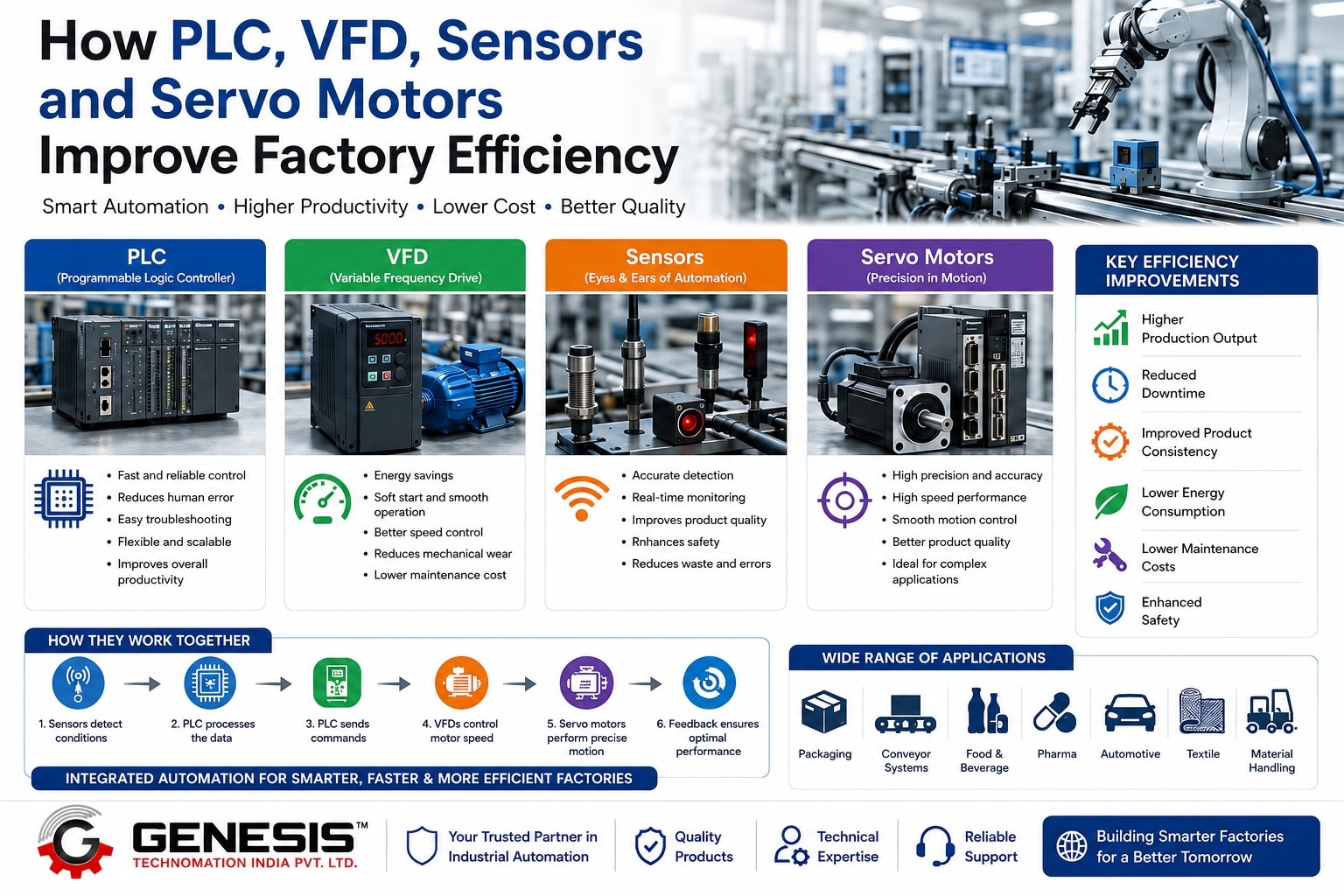
In today's competitive manufacturing environment, industries are constantly looking for ways to increase productivity, reduce downtime, improve product quality, and lower operating costs. Industrial automation technologies such as PLCs (Programmable Logic Controllers), VFDs (Variable Frequency Drives), Sensors, and Servo Motors play a vital role in achieving these goals. When integrated together, these automation components create a smart and efficient manufacturing system that delivers consistent performance and enhanced operational efficiency.
What is a PLC (Programmable Logic Controller)?
A PLC is the brain of an industrial automation system. It receives information from sensors, processes the data, and sends commands to machines and equipment.
Benefits of PLCs:
- Fast and reliable machine control
- Reduces human errors
- Easy troubleshooting and maintenance
- Flexible and scalable automation solutions
- Improves overall production efficiency
- Enables real-time monitoring and process control
PLCs are widely used in packaging machines, conveyor systems, assembly lines, food processing plants, and many other industrial applications.
What is a VFD (Variable Frequency Drive)?
A Variable Frequency Drive controls the speed and torque of AC motors by adjusting the frequency and voltage supplied to the motor.
Benefits of VFDs:
- Significant energy savings
- Smooth motor starting and stopping
- Precise speed control
- Reduced mechanical wear and tear
- Lower maintenance costs
- Extended motor lifespan
VFDs are commonly used in pumps, fans, compressors, conveyors, and material handling systems where variable speed operation is required.
The Importance of Sensors in Industrial Automation
Sensors are often called the "eyes and ears" of an automation system. They detect physical changes such as position, distance, pressure, temperature, color, presence, and movement.
Benefits of Sensors:
- Accurate object detection
- Real-time process monitoring
- Improved product quality
- Enhanced workplace safety
- Reduced waste and production errors
- Increased automation reliability
Common sensor types include:
- Photoelectric Sensors
- Proximity Sensors
- Ultrasonic Sensors
- Fiber Optic Sensors
- Laser Distance Sensors
- Color and Contrast Sensors
Sensors provide critical information to PLCs, enabling intelligent decision-making and process control.
What are Servo Motors?
Servo motors are precision motion control devices designed for applications requiring high accuracy, speed, and positioning control.
Benefits of Servo Motors:
- High precision and repeatability
- Fast response time
- Smooth and controlled motion
- Improved product quality
- High-speed operation
- Ideal for complex automation tasks
Servo motors are extensively used in CNC machines, robotics, packaging equipment, printing machines, and automated assembly systems.
How PLCs, VFDs, Sensors, and Servo Motors Work Together
An integrated automation system combines these technologies to create a highly efficient production process:
Step 1: Sensors Detect Conditions
Sensors monitor machine status, product position, speed, and process parameters.
Step 2: PLC Processes Data
The PLC collects information from sensors and analyzes the data according to programmed logic.
Step 3: PLC Sends Commands
Based on the processed information, the PLC sends instructions to VFDs and servo systems.
Step 4: VFD Controls Motor Speed
The VFD adjusts motor speed to optimize machine performance and energy consumption.
Step 5: Servo Motors Perform Precise Motion
Servo motors execute highly accurate positioning and motion control tasks.
Step 6: Continuous Feedback
Sensors continuously provide feedback to ensure optimal machine performance and process stability.
Key Efficiency Improvements Achieved Through Automation
Higher Production Output
Automated systems operate faster and more consistently than manual processes, increasing productivity.
Reduced Downtime
Real-time monitoring and predictive maintenance help prevent unexpected equipment failures.
Improved Product Consistency
Precise control minimizes variations and ensures uniform product quality.
Lower Energy Consumption
VFDs optimize motor operation and significantly reduce power usage.
Reduced Maintenance Costs
Smooth motor operation decreases mechanical stress and equipment wear.
Enhanced Safety
Automation reduces direct human interaction with hazardous machinery and environments.
Applications Across Industries
Industrial automation solutions are widely used in:
- Packaging Industry
- Conveyor Systems
- Food & Beverage Manufacturing
- Pharmaceutical Industry
- Automotive Manufacturing
- Textile Industry
- Material Handling Systems
- Robotics and Assembly Lines
- Printing and Labeling Machines
Why Choose Genesis Technomation India Pvt. Ltd.?
Genesis Technomation India Pvt. Ltd. provides a comprehensive range of industrial automation products and solutions, including:
- PLC Systems
- Variable Frequency Drives (VFDs)
- Industrial Sensors
- Servo Motors & Servo Drives
- Industrial Networking Solutions
- Motion Control Products
- Automation Accessories
With technical expertise, quality products, and reliable support, Genesis Technomation helps industries build smarter, more efficient, and future-ready factories.
Conclusion
PLCs, VFDs, Sensors, and Servo Motors are the foundation of modern industrial automation. Together, they enable manufacturers to improve productivity, reduce costs, enhance quality, and achieve greater operational efficiency. By implementing integrated automation solutions, industries can stay competitive and meet the growing demands of modern manufacturing.
