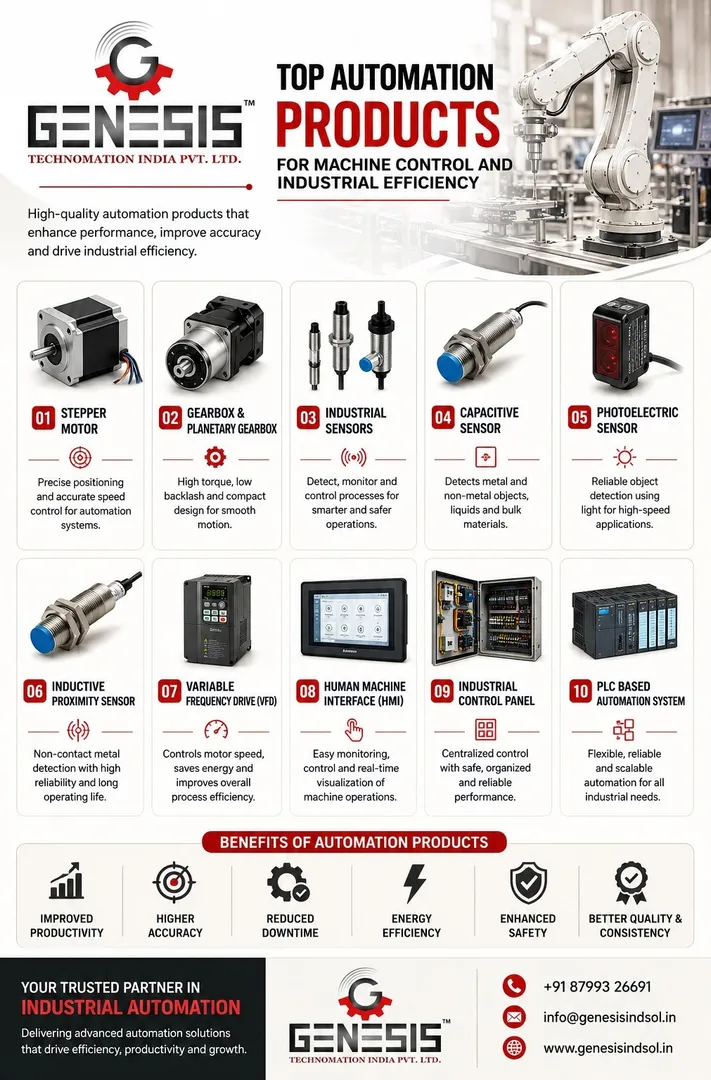
Industrial automation is transforming the way modern industries manufacture, process, and manage products. As businesses look for better productivity, improved accuracy, reduced downtime, and greater operational efficiency, automation products have become an essential part of industrial machinery and production systems.
From precision motion control to advanced sensing and intelligent machine monitoring, every automation component plays an important role in creating a reliable and efficient industrial environment.
At Genesis Technomation India Pvt. Ltd., we offer automation solutions and products designed to support machine builders, manufacturers, system integrators, and industries with reliable technology for modern industrial applications.
What Is Industrial Automation?
Industrial automation is the use of control systems, machines, sensors, software, and industrial equipment to perform manufacturing and production processes with minimum manual intervention.
Automation systems can control:
- Machine movement
- Motor speed
- Product detection
- Positioning
- Material handling
- Production processes
- Machine monitoring
- Industrial equipment
A modern automation system typically combines multiple components, including motors, gearboxes, sensors, VFDs, HMIs, PLCs, and industrial control panels.
When these products work together, they help businesses achieve higher productivity, better accuracy, improved safety, and consistent production quality.
Top Automation Products for Machine Control
1. Stepper Motors
Stepper motors are widely used in industrial automation applications that require precise positioning and accurate movement. A stepper motor moves in controlled steps, allowing machines to achieve excellent positioning accuracy and repeatability.
These motors are suitable for applications where precise movement is more important than continuous high-speed operation.
Common Applications
Stepper motors are commonly used in:
- CNC machines
- 3D printers
- Packaging machines
- Labeling machines
- Textile machinery
- Printing equipment
- Pick-and-place systems
- Automation machines
Key Benefits
- Precise positioning
- Accurate movement
- Excellent repeatability
- Controlled speed
- Reliable operation
- Easy integration with automation systems
A stepper motor is an excellent solution for applications that require accurate motion control and repeatable machine movement.
2. Gearbox and Planetary Gearbox
Gearboxes are used to transmit mechanical power while controlling speed and torque. They play an important role in converting motor output into the required mechanical movement for industrial machinery.
Planetary gearboxes are particularly popular in high-precision applications because of their compact design, high torque transmission capacity, and low backlash.
Applications of Gearboxes
- Robotics
- CNC machines
- Packaging machinery
- Servo motor systems
- Automation equipment
- Material handling systems
- Industrial machinery
Advantages of Planetary Gearboxes
- High torque transmission
- Compact design
- Low backlash
- High precision
- Smooth motion
- High efficiency
- Long service life
A high-quality gearbox can significantly improve the performance and reliability of a machine's motion control system.
3. Industrial Sensors
Industrial sensors are essential components of modern automation systems. Sensors allow machines to detect objects, monitor conditions, identify positions, and collect information from the production environment.
The information collected by sensors is sent to a control system such as a PLC or controller, which then takes the required action.
Industrial Sensor Applications
Sensors are used for:
- Object detection
- Product counting
- Position sensing
- Machine monitoring
- Process control
- Material detection
- Safety monitoring
By reducing the need for manual inspection, sensors help improve production speed, accuracy, and operational safety.
4. Capacitive Sensors
Capacitive sensors detect objects by sensing changes in capacitance. Unlike inductive sensors, capacitive sensors can detect both metallic and non-metallic materials.
They can detect a wide range of materials, including:
- Plastic
- Glass
- Wood
- Paper
- Liquids
- Powder
- Granules
- Metals
Applications
Capacitive sensors are widely used in:
- Liquid level detection
- Packaging machines
- Plastic product detection
- Material handling
- Powder detection
- Food processing
- Bulk material applications
Benefits
- Detects metal and non-metal materials
- Suitable for liquid detection
- Non-contact operation
- Easy installation
- Reliable performance
Capacitive sensors are a practical solution for applications where material detection is required without physical contact.
5. Photoelectric Sensors
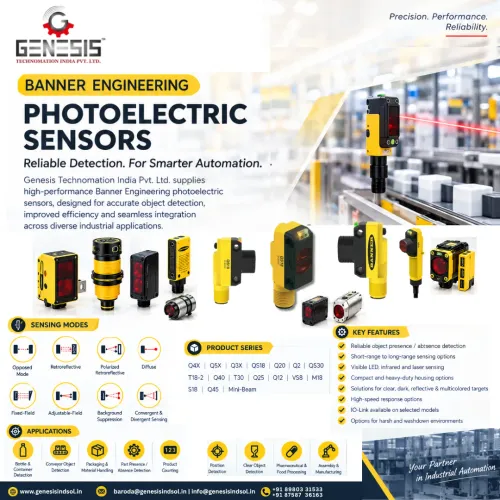
Photoelectric sensors use light to detect the presence, absence, position, or movement of objects. These sensors are highly useful in automated production lines and high-speed industrial applications.
They can detect objects without making physical contact.
Common Applications
- Product detection
- Object counting
- Conveyor systems
- Packaging machines
- Bottle detection
- Labeling systems
- Assembly lines
Advantages
- Fast response
- Non-contact detection
- Long sensing range
- Suitable for high-speed operations
- Reliable object detection
- Easy integration into automation systems
Photoelectric sensors help improve the speed and accuracy of automated production processes.
6. Inductive Proximity Sensors
Inductive proximity sensors are designed to detect metallic objects without physical contact. They use an electromagnetic field to identify the presence of metal objects.
These sensors are widely used in industrial automation because of their reliability and durability.
Applications
- Metal part detection
- Position detection
- Machine automation
- Product counting
- Limit detection
- Assembly machines
- Conveyor systems
Key Benefits
- Non-contact operation
- High reliability
- Fast response
- Long operating life
- Resistant to dust and oil
- Low maintenance requirements
Inductive proximity sensors are ideal for demanding industrial environments where reliable metal detection is required.
7. Variable Frequency Drive (VFD)
A Variable Frequency Drive, or VFD, controls the speed and torque of an AC motor by adjusting the frequency and voltage supplied to the motor.
VFDs allow motors to operate according to the actual requirements of a process instead of running continuously at full speed.
Applications of VFDs
- Pumps
- Fans
- Conveyors
- Compressors
- Industrial machinery
- HVAC systems
- Production equipment
Benefits of VFDs
- Precise motor speed control
- Energy savings
- Smooth motor starting
- Reduced mechanical stress
- Improved process control
- Motor protection
- Better operational efficiency
By controlling motor speed more efficiently, VFDs can help reduce energy consumption and improve overall machine performance.
8. Human Machine Interface (HMI)
A Human Machine Interface, commonly known as an HMI, provides an interface between the machine and the operator.
Through an HMI, operators can monitor machine conditions, control processes, adjust parameters, and receive alarm notifications.
HMI Functions
- Machine monitoring
- Process control
- Parameter setting
- Alarm display
- Production monitoring
- Real-time data visualization
Benefits
- Easy machine operation
- User-friendly interface
- Real-time monitoring
- Quick troubleshooting
- Improved operator control
- Better visibility of machine performance
An HMI makes complex automation systems easier to operate and manage.
9. Industrial Control Panels
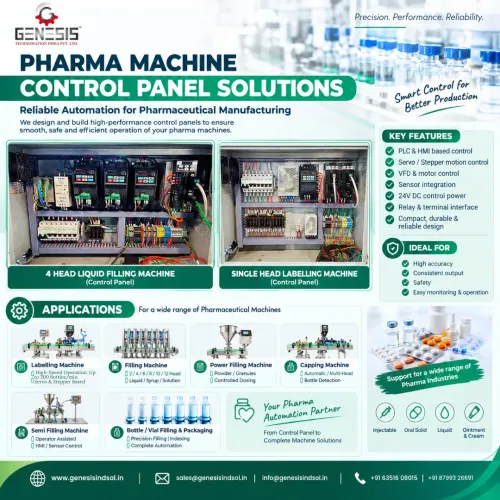
Industrial control panels are the central control systems of automated machines. They contain electrical and automation components that work together to control the machine.
A typical industrial control panel may include:
- PLCs
- VFDs
- Contactors
- Relays
- Circuit breakers
- Power supplies
- Terminal blocks
- Communication devices
Benefits of Industrial Control Panels
- Centralized machine control
- Improved electrical organization
- Easy maintenance
- Enhanced system protection
- Reliable machine operation
- Improved troubleshooting
A professionally designed control panel ensures that automation components are properly organized, protected, and connected.
10. PLC-Based Automation Systems
A Programmable Logic Controller, or PLC, is an industrial control computer designed to automate machines and processes.
PLCs receive input signals from sensors, process the information according to programmed logic, and control output devices.
PLC Applications
- Manufacturing machines
- Packaging lines
- Conveyor systems
- Assembly machines
- Process automation
- Production lines
- Material handling
Advantages
- Reliable industrial operation
- Flexible programming
- Easy troubleshooting
- Real-time machine control
- Scalable automation
- Suitable for complex processes
PLC-based systems provide the flexibility and reliability required for modern industrial automation.
How Automation Products Improve Industrial Efficiency
The correct combination of automation products can significantly improve the overall performance of a machine or production line.
Improved Productivity
Automation enables machines to operate continuously and consistently. This can help increase production output and reduce unnecessary delays.
Higher Accuracy
Automation products such as stepper motors, sensors, and PLCs provide precise control and repeatable operation.
Reduced Downtime
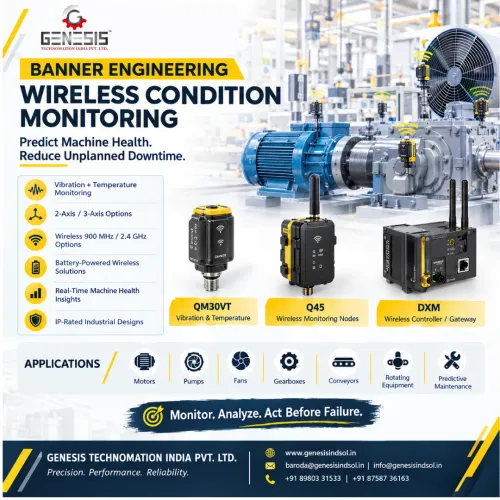
Sensors and monitoring systems help detect machine conditions and potential issues, allowing problems to be identified earlier.
Energy Efficiency
VFDs help control motor speed according to actual process requirements, which can reduce unnecessary energy consumption.
Enhanced Safety
Automation systems can monitor operating conditions and help reduce the need for manual intervention in potentially hazardous processes.
Better Quality and Consistency
Automated systems perform repetitive tasks consistently, helping industries maintain stable product quality.
Applications of Industrial Automation Products
Automation products are used across a wide range of industries.
Manufacturing
Automation products help improve production speed, accuracy, and process control.
Packaging
Sensors, motors, gearboxes, HMIs, and PLCs are widely used in packaging machinery.
Automotive
Automation systems support assembly, inspection, material handling, and production processes.
Food and Beverage
Sensors and automation controls are used for product detection, packaging, processing, and production monitoring.
Pharmaceutical
Precise automation is essential for controlled production and quality requirements.
Textile
Motors, sensors, drives, and controllers help automate textile manufacturing processes.
Material Handling
Conveyors, motors, sensors, and PLC systems help automate the movement and management of materials.
Process Industries
Automation products are used to monitor and control complex industrial processes.
Why Choosing the Right Automation Products Matters
Every machine has unique requirements. Selecting the right automation products is important for achieving optimum performance.
Before choosing a product, businesses should consider:
Machine Requirements
Understand the application, operating conditions, required speed, and control requirements.
Load and Torque
For motors and gearboxes, the required load, torque, speed, and duty cycle should be carefully evaluated.
Sensing Distance
The required sensing distance and type of material should be considered when selecting sensors.
Environmental Conditions
The product should be suitable for the working environment, including:
- Dust
- Oil
- Moisture
- Heat
- Vibration
- Chemicals
System Compatibility
All components should be compatible with the existing automation system.
Technical Support
Selecting products from an experienced automation partner can simplify installation, troubleshooting, and maintenance.
The Future of Industrial Automation
Industrial automation continues to evolve with advancements in smart manufacturing, industrial communication, robotics, data monitoring, and connected machines.
Modern automation systems are becoming:
- More intelligent
- More connected
- More energy-efficient
- More flexible
- Easier to monitor
- More data-driven
The combination of sensors, controllers, drives, HMIs, motors, and industrial communication systems is helping industries move toward smarter manufacturing environments.
Businesses that invest in the right automation technology can improve productivity, reduce operational costs, and remain competitive in a rapidly changing industrial environment.
Your Trusted Partner in Industrial Automation
At Genesis Technomation India Pvt. Ltd., we understand the importance of reliable automation products for modern industrial applications.
Our automation solutions are designed to support:
- Machine manufacturers
- Industrial manufacturers
- System integrators
- Automation engineers
- Production industries
- Process industries
From motion control and sensing to machine monitoring and control systems, the right automation solution can help improve productivity, accuracy, and overall machine performance.
Conclusion
Industrial automation products are the foundation of modern machine control and industrial efficiency.
From stepper motors and planetary gearboxes to industrial sensors, capacitive sensors, photoelectric sensors, inductive proximity sensors, VFDs, HMIs, control panels, and PLC-based automation systems, each product plays an important role in creating a reliable and efficient automated system.
By selecting the right automation components, industries can achieve:
- Improved productivity
- Higher accuracy
- Reduced downtime
- Better energy efficiency
- Enhanced safety
- Improved product quality
- Consistent machine performance
Whether you are building a new machine, upgrading an existing automation system, or looking for reliable industrial automation products, choosing the right technology and automation partner is essential.
Genesis Technomation India Pvt. Ltd. is committed to delivering reliable industrial automation solutions that help businesses achieve smarter machine control, better productivity, and long-term industrial efficiency.
📧 info@genesisindsol.in
Keywords