Photoelectric Sensor
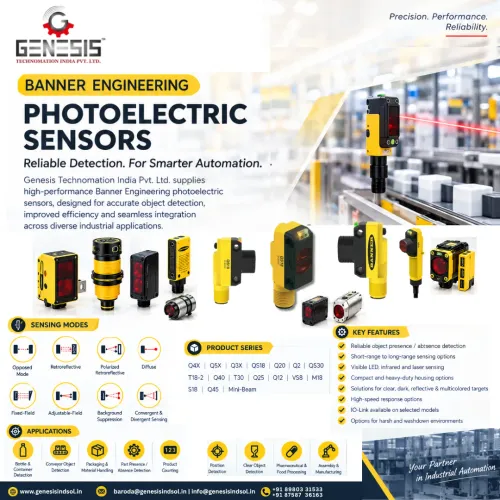
Industrial automation depends heavily on accurate and reliable object detection. One of the most widely used sensing technologies in factories, packaging plants, and production lines is the photoelectric sensor. These sensors use light to detect the presence, absence, or distance of objects, making them extremely useful in modern automated systems.
Photoelectric sensors are commonly used in manufacturing, logistics, robotics, food processing, packaging, and conveyor systems. Their fast response time, non-contact sensing, and high reliability make them an essential component of industrial automation.
In this detailed guide, we will explore what photoelectric sensors are, how they work, their types, advantages, applications, and why they are essential for modern industries.
What is a Photoelectric Sensor?
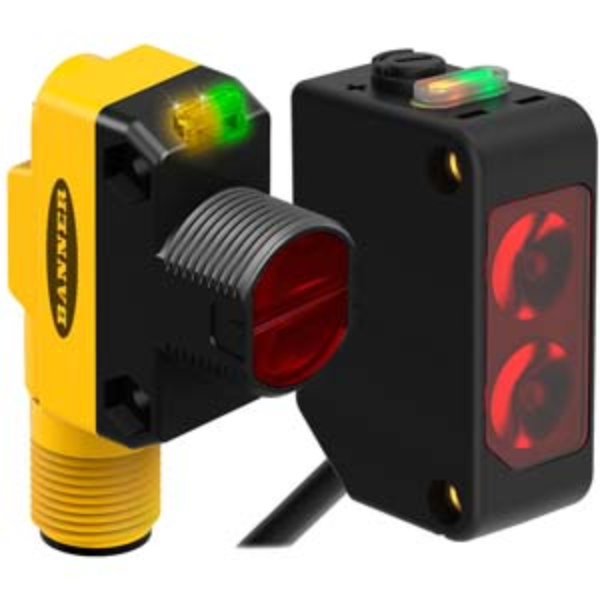
A photoelectric sensor is an electronic device that detects objects, changes in surface conditions, or distance by using a beam of light. The sensor emits light (usually infrared or visible red light) and detects changes in the light signal when an object interrupts or reflects the beam.
Unlike mechanical switches or contact sensors, photoelectric sensors operate without physical contact, making them ideal for detecting fast-moving or delicate objects.
Key Components of a Photoelectric Sensor
A typical photoelectric sensor consists of three main components:
1. Light Emitter
The emitter generates a beam of light, usually using an LED or laser diode.
2. Receiver
The receiver detects the light emitted by the transmitter. When an object blocks or reflects the beam, the receiver registers the change.
3. Signal Processing Circuit
The electronic circuit processes the received signal and sends an output signal to a PLC, controller, or machine.
Types of Photoelectric Sensors
1. Through-Beam Photoelectric Sensor
There are three main types of photoelectric sensors used in industrial automation.
Through-beam sensors consist of two separate units:
· Emitter (transmitter)
· Receiver
The emitter sends a beam of light directly to the receiver. When an object passes between them and blocks the beam, the sensor detects it.
Advantages
· Long detection distance
· High accuracy
· Reliable detection in dusty environments
Detection Range
Up to 10–30 meters depending on the model.
Applications
· Conveyor belt object detection
· Pallet detection in warehouses
· Counting products in production lines
· Security gate detection
2. Retro-Reflective Photoelectric Sensor
Retro-reflective sensors use a reflector to bounce the emitted light back to the sensor.
In this system:
· The emitter and receiver are inside the same sensor housing.
· A reflector is placed opposite the sensor.
· When an object blocks the reflected beam, the sensor detects it.
Advantages
· Easy installation
· Moderate sensing range
· Requires only one sensor unit
Detection Range
Usually 2–10 meters depending on the reflector.
Applications
· Packaging machines
· Bottle detection in filling lines
· Warehouse automation
· Entry/exit detection systems
3. Diffuse Photoelectric Sensor
In this configuration:
· The emitter and receiver are inside the same housing.
· The object reflects the emitted light back to the receiver.
Advantages
· No reflector required
· Simple installation
· Ideal for short-range detection
Detection Range
Usually 50 mm to 2 meters.
Applications
· Object detection on conveyor belts
· Presence detection in packaging machines
· Robotic pick-and-place systems
· Industrial sorting machines
4.Fiber Optic Photoelectric Sensor
Features
- Detects very small objects
- Works in tight spaces
- High precision
Applications
- Electronics manufacturing
- Semiconductor industry
- Small component detection
Key Features of Photoelectric Sensors
Modern industrial photoelectric sensors offer several advanced features that improve reliability and performance.
1. Fast Response Time
Photoelectric sensors have very fast switching speeds, typically within milliseconds, making them ideal for high-speed production lines.
2. Non-Contact Detection
Because detection occurs using light, there is no physical contact with the object, which reduces wear and mechanical damage.
3. Long Detection Distance
Compared to proximity sensors, photoelectric sensors offer much longer sensing ranges.
4. High Precision
These sensors can detect very small objects with high accuracy.
5. Compact Design
Many sensors come in small and compact housings, allowing easy installation in tight spaces.
6. LED Status Indicators
Most industrial sensors include LED indicators for quick alignment and troubleshooting.
Advantages of Photoelectric Sensors in Industrial Automation
Photoelectric sensors provide several benefits that make them widely used in industrial systems.
Increased Productivity
Automated detection enables machines to operate faster and more efficiently.
Improved Accuracy
Sensors ensure precise object detection, reducing manufacturing errors.
Reduced Maintenance
Since there is no mechanical contact, sensors have longer operational life.
Energy Efficient
Photoelectric sensors consume very low power while providing high performance.
Versatile Applications
They can detect a wide range of materials including:
· Metal
· Plastic
· Glass
· Paper
· Liquid containers
· Transparent objects (with specialized sensors)
Applications of Photoelectric Sensors
Photoelectric sensors are used in many industries due to their versatility and reliability.
1. Conveyor Belt Systems
They detect products moving along conveyor belts and help in:
· Counting items
· Sorting packages
· Detecting blockages
2. Packaging Industry
Sensors ensure accurate packaging by detecting:
· Bottles
· Boxes
· Labels
· Caps
3. Automotive Manufacturing
Photoelectric sensors are used for:
· Robot positioning
· Component detection
· Assembly line automation
4. Food and Beverage Industry
They help detect food items and containers while maintaining hygiene due to contactless operation.
5. Logistics and Warehousing
Sensors are widely used in:
· Automated storage systems
· Parcel sorting machines
· Pallet detection
6. Pharmaceutical Industry
They help detect small containers, tablets, and packaging materials during production.
Why Photoelectric Sensors Are Essential for Modern Automation
Photoelectric sensors play a critical role in automated manufacturing systems. Their ability to detect objects quickly, accurately, and without contact makes them indispensable in modern industries.
From conveyor belt monitoring to robotic automation, these sensors ensure that production lines run smoothly and efficiently.
Companies investing in industrial automation rely on high-quality sensors to improve productivity, accuracy, and system reliability.
Conclusion
Photoelectric sensors are among the most important sensing devices used in industrial automation. Their ability to detect objects using light provides fast, reliable, and contactless detection, making them ideal for a wide range of applications.
With different types such as through-beam, retro-reflective, and diffuse sensors, industries can choose the most suitable option for their automation systems.
As factories continue moving toward smart manufacturing and Industry 4.0, photoelectric sensors will remain a critical component in ensuring efficient and accurate industrial operations.