How Industrial Control Panels Improve Machine Performance
In today’s fast-evolving industrial environment, manufacturers are constantly looking for ways to improve productivity, reduce downtime, enhance safety, and achieve better control over their machines and production processes. This is where industrial control panels play a critical role.
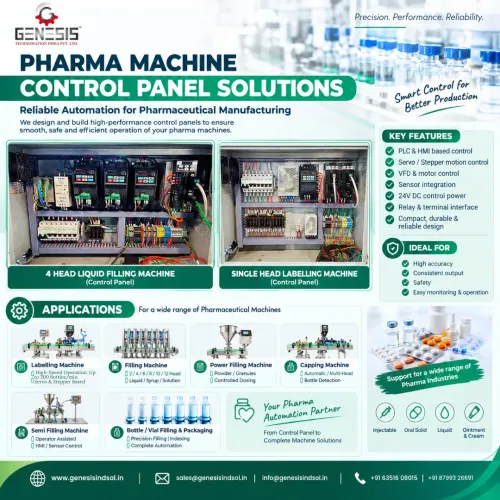
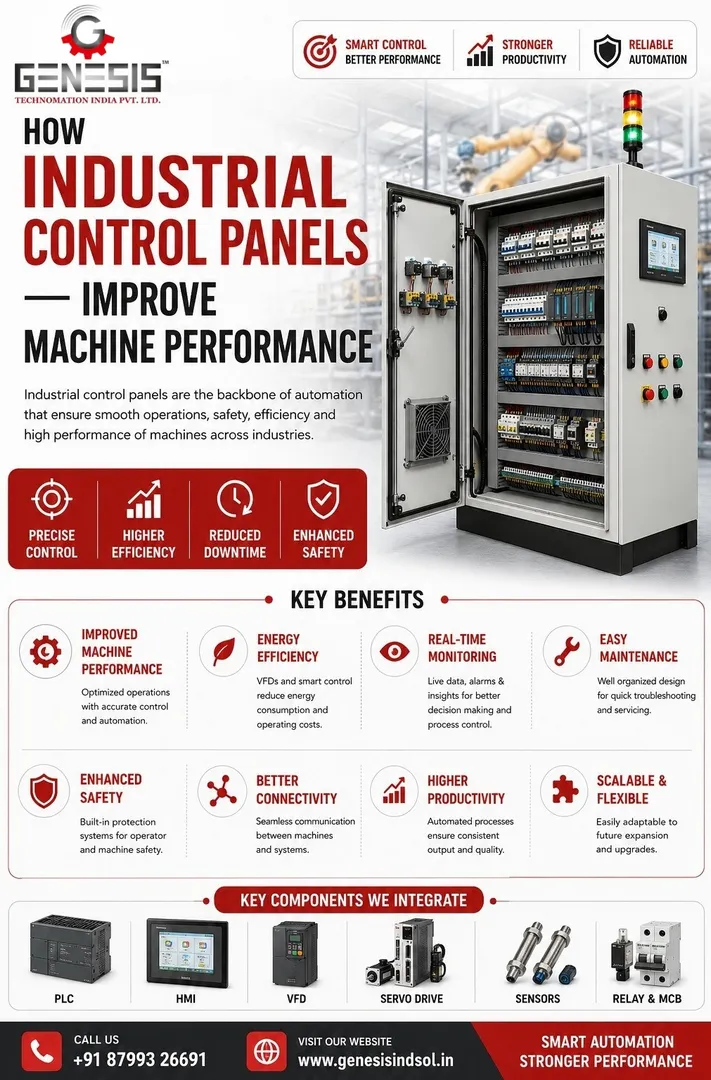
An industrial control panel is the central control system of an automated machine or industrial process. It integrates essential automation components such as PLCs, HMIs, VFDs, servo drives, sensors, relays, circuit breakers, and communication systems to ensure smooth, reliable, and efficient machine operation.
At Genesis Technomation India Pvt. Ltd., we design and integrate smart industrial control panel solutions that help businesses achieve precise control, higher efficiency, reduced downtime, enhanced safety, and improved machine performance.
What Is an Industrial Control Panel?
An industrial control panel is an electrical enclosure that contains various control and automation components required to operate and monitor industrial machinery.
Depending on the application, a control panel may include:
- PLC (Programmable Logic Controller)
- HMI (Human Machine Interface)
- VFD (Variable Frequency Drive)
- Servo Drive and Servo Motor Control
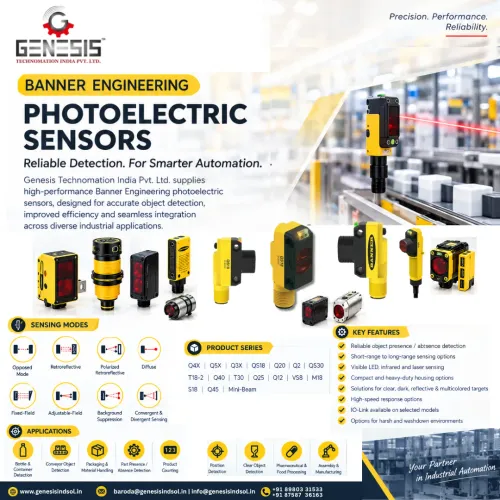
- Industrial Sensors
- Relays and Contactors
- MCBs and Protection Devices
- Power Supplies
- Communication Modules
- Terminal Blocks
- Industrial Networking Components
All these components work together to control machine functions, monitor real-time conditions, and ensure that the complete automation system operates safely and efficiently.
How Industrial Control Panels Improve Machine Performance
1. Precise Machine Control
One of the biggest advantages of an industrial control panel is accurate and precise machine control.
A PLC-based control system allows machines to perform operations according to predefined programming logic. Every movement, timing sequence, speed, and process can be controlled with high accuracy.
This helps industries achieve:
- Accurate machine operation
- Consistent production
- Better process control
- Reduced human error
- Improved product quality
Whether it is a packaging machine, conveyor system, CNC machine, material handling system, or production line, a properly designed control panel ensures that every operation is performed as required.
2. Improved Machine Performance
A well-designed control panel optimizes the overall operation of industrial machinery.
The system continuously controls and coordinates different machine components, allowing them to work together efficiently. This results in smoother operation, faster response, and improved machine performance.
With advanced automation components, machines can achieve:
- Better operating accuracy
- Faster response time
- Consistent performance
- Reduced process interruptions
- Optimized machine cycles
A smart control panel acts as the central brain of the machine, coordinating all automation functions efficiently.
3. Higher Productivity
Industrial automation control panels help increase production efficiency by automating repetitive and complex operations.
Automated machines can operate continuously with minimal manual intervention. This helps industries improve production output while maintaining consistent quality.
A control panel can help:
- Automate repetitive tasks
- Reduce manual dependency
- Improve production speed
- Maintain consistent machine cycles
- Increase overall output
By integrating PLCs, VFDs, servo systems, and sensors, manufacturers can create highly efficient automated production systems.
4. Reduced Machine Downtime
Unexpected machine downtime can cause significant production losses. Industrial control panels help reduce downtime by providing better control, monitoring, and fault detection.
Modern control panels can monitor machine conditions and identify problems such as:
- Motor overload
- High temperature
- Voltage problems
- Sensor failure
- Communication errors
- Drive faults
- Electrical system failures
When an abnormal condition occurs, the system can generate alarms and fault indications. This allows operators and maintenance teams to quickly identify and solve the problem.
Less downtime means higher productivity and better operational efficiency.
5. Energy Efficiency
Energy efficiency is an important factor for modern industries. Industrial control panels can help reduce unnecessary energy consumption through intelligent control systems.
For example, Variable Frequency Drives (VFDs) can control motor speed according to actual process requirements. Instead of running motors continuously at full speed, the system can adjust the speed based on demand.
This helps in:
- Reducing energy consumption
- Lowering operating costs
- Improving motor efficiency
- Reducing mechanical stress
- Increasing motor life
Smart automation systems can help industries achieve better energy management and more sustainable operations.
6. Real-Time Machine Monitoring
Modern industrial control panels can provide real-time information about machine and process performance.
When an HMI is integrated with the control panel, operators can view important information such as:
- Machine status
- Production data
- Motor speed
- Temperature
- Pressure
- Alarms
- Fault conditions
- Energy consumption
- Process parameters
This real-time information allows operators to make faster and better decisions.
Instead of waiting for a machine failure, operators can identify abnormal conditions early and take preventive action.
7. Enhanced Operator and Machine Safety
Safety is one of the most important aspects of industrial automation.
Industrial control panels include various safety and protection components to protect:
- Operators
- Machines
- Electrical systems
- Production processes
Protection devices such as MCBs, overload relays, fuses, circuit breakers, and safety systems help protect the system from electrical faults and abnormal conditions.
Depending on the application, control panels can also integrate:
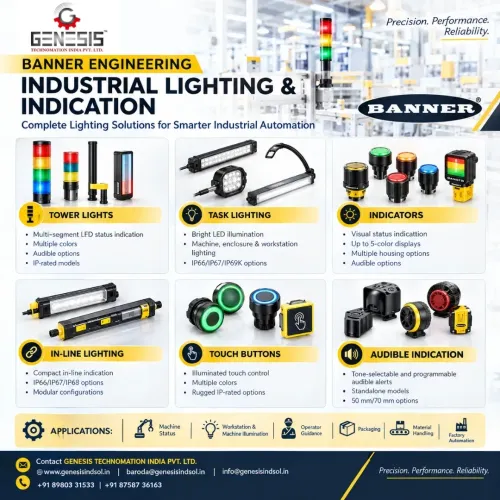
- Emergency stop systems
- Safety relays
- Door interlocking
- Overload protection
- Short-circuit protection
- Motor protection
- Safety sensors
A properly designed industrial control panel helps create a safer working environment.
Key Components Integrated in Industrial Control Panels
PLC – The Brain of Automation
A Programmable Logic Controller (PLC) is one of the most important components in an industrial control panel.
The PLC receives signals from sensors, processes the programmed logic, and sends commands to machines and other devices.
PLCs are widely used for:
- Machine automation
- Conveyor control
- Packaging systems
- Production lines
- Process automation
- Material handling
- Industrial machinery
PLC-based systems provide reliable and flexible machine control.
HMI – Easy Machine Operation and Monitoring
A Human Machine Interface (HMI) allows operators to interact with machines through a graphical display.
Operators can:
- Start and stop machines
- Monitor machine status
- View alarms
- Change process parameters
- Monitor production data
- Identify faults
An HMI makes complex automation systems easier to operate and monitor.
VFD – Efficient Motor Speed Control
A Variable Frequency Drive (VFD) controls the speed and operation of AC motors.
VFDs help provide:
- Variable speed control
- Smooth motor starting
- Energy savings
- Reduced mechanical stress
- Better process control
They are commonly used in pumps, fans, conveyors, compressors, and many other industrial applications.
Servo Drives – High-Speed and High-Precision Motion
Servo drives are used for applications that require accurate positioning and high-speed motion control.
They are ideal for:
- CNC machines
- Robotic systems
- Packaging machines
- Pick-and-place systems
- Printing machines
- Precision automation
Servo systems help achieve accurate movement, positioning, and speed control.
Sensors – Intelligent Machine Feedback
Sensors provide important information about machine and process conditions.
Different types of industrial sensors can detect:
- Object presence
- Position
- Distance
- Metal objects
- Product movement
- Temperature
- Pressure
- Level
Sensors send real-time feedback to the PLC, allowing the machine to respond automatically to changing conditions.
Relays, MCBs and Protection Devices
Electrical protection components are essential for the safe operation of industrial control panels.
They help protect the system from:
- Short circuits
- Overloads
- Voltage problems
- Electrical faults
Proper protection improves the reliability and safety of the complete automation system.
Benefits of a Well-Designed Industrial Control Panel
A professionally designed control panel can provide several important benefits:
Improved Machine Performance
Accurate control and automation help machines operate more efficiently.
Better Energy Efficiency
Smart motor control and automation reduce unnecessary energy consumption.
Real-Time Monitoring
Operators can monitor machine status and process conditions instantly.
Easy Maintenance
Organized panel design makes troubleshooting and servicing easier.
Enhanced Safety
Protection and safety systems help protect operators and equipment.
Better Connectivity
Modern control systems can communicate with other machines, systems, and industrial networks.
Higher Productivity
Automated processes improve production speed and consistency.
Scalable Automation
The system can be upgraded and expanded as business requirements grow.
Why Control Panel Design Matters
The performance of an industrial automation system depends heavily on the quality of its control panel design.
A professional control panel should include:
- Proper component selection
- Correct electrical protection
- Efficient wiring
- Proper heat management
- Organized component layout
- Clear labeling
- Easy maintenance access
- Proper safety design
- Reliable communication systems
A well-organized control panel not only improves machine performance but also makes troubleshooting and maintenance faster and easier.
Applications of Industrial Control Panels
Industrial control panels are used across various industries, including:
- Manufacturing
- Packaging
- Pharmaceuticals
- Food Processing
- Textile
- Automotive
- Chemical Industries
- Material Handling
- Water Treatment
- Printing
- Plastic Industries
- Robotics
- Process Automation
From individual machines to complete production lines, industrial control panels provide reliable and intelligent control.
The Future of Industrial Automation
The future of industrial automation is moving toward smarter, more connected, and data-driven systems.
Modern control panels are increasingly being integrated with:
- Industrial IoT
- Remote monitoring
- Smart sensors
- Industrial networking
- Data analytics
- Cloud connectivity
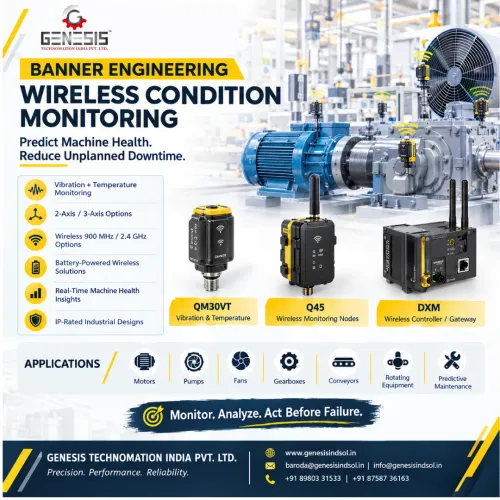
- Predictive maintenance
These technologies help businesses move toward smart manufacturing and Industry 4.0.
With advanced automation, industries can monitor machine performance, analyze production data, identify potential problems, and improve operational efficiency.
Conclusion
Industrial control panels are the backbone of modern machine automation. They bring together control, monitoring, protection, communication, and automation technologies into one centralized system.
From improving machine accuracy and productivity to reducing energy consumption and downtime, a professionally designed control panel can significantly improve overall machine performance.
For industries looking to improve automation, increase productivity, enhance safety, and build reliable machine control systems, investing in a high-quality industrial control panel is an important step toward long-term operational success.
Genesis Technomation India Pvt. Ltd. provides smart industrial automation and control panel solutions designed to deliver:
Smart Control. Better Performance. Stronger Productivity. Reliable Automation.
Looking for reliable industrial automation and control panel solutions?
Contact Genesis Technomation India Pvt. Ltd.
📞 +91 87993 26691
🌐 www.genesisindsol.in
Keywords