Capacitive proximity sensors are essential sensing devices used in modern industrial automation systems for detecting the presence, absence, position, level, or movement of different materials without physical contact. Unlike traditional mechanical switches, capacitive proximity sensors operate electronically and can detect a wide variety of objects, including both metallic and non-metallic materials.
From plastic and glass to liquids, powders, grains, wood, paper, and metal, capacitive sensors offer flexible and reliable detection for a wide range of industrial applications. Their non-contact operation, fast response, adjustable sensing distance, and long service life make them an ideal solution for automated machines and production systems.
Whether used in packaging machinery, conveyor systems, liquid-level monitoring, material handling, food processing, pharmaceutical production, or chemical industries, capacitive proximity sensors help improve automation efficiency, process reliability, and machine performance.
What Is a Capacitive Proximity Sensor?
A capacitive proximity sensor is an electronic sensing device that detects objects by sensing changes in an electrostatic field. When a target object comes within the sensor's detection range, it changes the capacitance of the sensing field. The sensor detects this change and generates an output signal.
This output signal can be sent to a PLC, controller, relay, HMI system, or other automation equipment to control a machine operation.
Simple Working Principle
Target Object → Change in Electrostatic Field → Capacitance Change → Sensor Detection → Output Signal
Because capacitive sensors do not require direct contact with the target object, they are suitable for applications where mechanical contact may cause wear, contamination, or product damage.
How Do Capacitive Proximity Sensors Work?
Capacitive proximity sensors work by generating an electrostatic field around the sensing face. The sensor contains a sensing electrode that continuously monitors changes in this field.
When an object enters the sensing range, the dielectric properties of the object cause a change in capacitance. The internal electronic circuit detects this change and switches the sensor output.
The output signal can then be used to:
- Start or stop a machine
- Count products
- Detect the presence of an object
- Monitor liquid levels
- Control filling systems
- Activate a conveyor
- Trigger a packaging operation
- Send feedback to a PLC
This makes capacitive proximity sensors an important part of automated control systems.
What Materials Can Capacitive Proximity Sensors Detect?
One of the biggest advantages of capacitive proximity sensors is their ability to detect a wide range of materials.
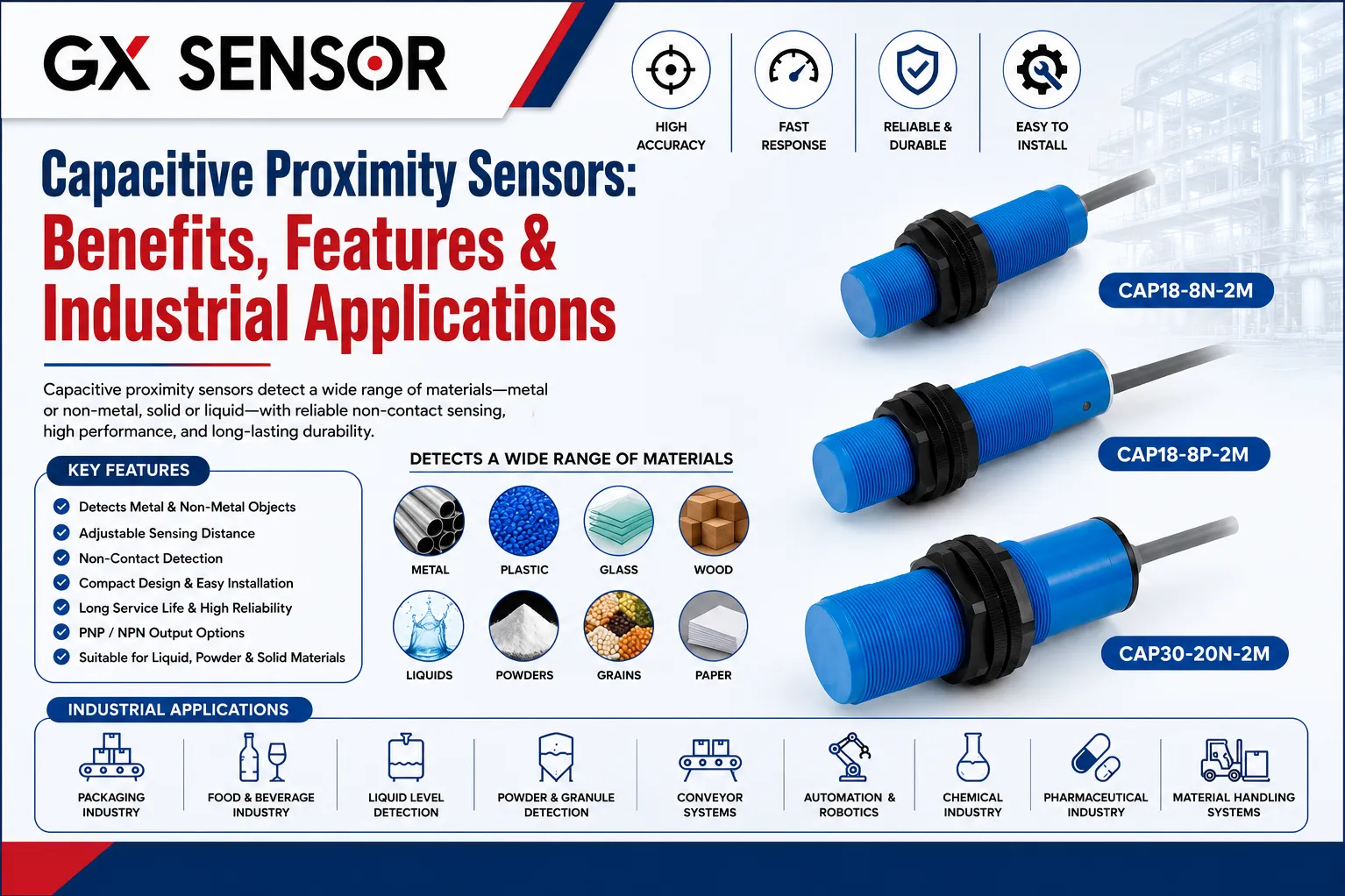
Commonly Detectable Materials
- Metal
- Plastic
- Glass
- Wood
- Paper
- Cardboard
- Rubber
- Ceramic
- Water
- Oil
- Chemicals
- Powders
- Granules
- Grains
- Pharmaceutical materials
The actual sensing distance depends on factors such as the material, object size, dielectric constant, sensor design, and installation conditions.
Key Features of Capacitive Proximity Sensors
1. Detection of Metal and Non-Metal Objects
Capacitive proximity sensors can detect both conductive and non-conductive materials. This makes them more versatile than sensors designed specifically for metal detection.
They can detect plastic containers, glass bottles, wooden products, paper packaging, liquid materials, and many other non-metallic objects.
2. Non-Contact Detection
Capacitive sensors detect objects without physically touching them.
This provides several benefits:
- No mechanical wear
- Reduced product damage
- Lower contamination risk
- Long sensor life
- Minimal maintenance
Non-contact detection is especially useful in high-speed manufacturing and automated production environments.
3. Adjustable Sensing Distance
Many capacitive proximity sensors feature adjustable sensitivity. This allows users to set the detection range according to the application requirements.
Sensitivity adjustment can help improve:
- Detection accuracy
- Product recognition
- Material detection
- False-trigger prevention
The sensing distance should be adjusted carefully to ensure reliable operation.
4. Fast Response
Capacitive proximity sensors provide fast detection and quick output response.
This makes them suitable for:
- High-speed conveyors
- Automated packaging machines
- Counting applications
- Product positioning
- Fast production lines
A fast response helps improve machine cycle time and overall productivity.
5. Compact Design
Capacitive sensors are available in compact cylindrical and rectangular designs.
Their compact construction allows easy installation in:
- Small machines
- Conveyor systems
- Packaging equipment
- Automated assembly systems
- Material handling equipment
6. Long Service Life
Since capacitive sensors have no mechanical moving parts, they can provide a long operating life when properly installed and used within the specified conditions.
This can reduce:
- Maintenance requirements
- Machine downtime
- Sensor replacement costs
7. PNP and NPN Output Options
Capacitive proximity sensors are available with different output configurations to suit various industrial control systems.
Common options include:
- PNP output
- NPN output
- Normally Open (NO)
- Normally Closed (NC)
Selecting the correct output type is important for compatibility with the PLC or control system.
Benefits of Capacitive Proximity Sensors
Versatile Material Detection
Capacitive sensors can detect materials that many other proximity sensors cannot detect. Their ability to sense both metallic and non-metallic objects makes them suitable for diverse industries.
Reliable Performance
Capacitive sensors provide consistent detection when correctly installed and adjusted according to the target material and application requirements.
Low Maintenance
Because capacitive sensors operate without physical contact, they generally require less maintenance than mechanical switches.
Suitable for Liquid Level Detection
Capacitive sensors can detect liquids through certain non-metallic container walls, depending on the application and sensor specifications.
This makes them useful for:
- Tank level monitoring
- Bottle detection
- Liquid filling machines
- Container level sensing
Suitable for Powder and Granule Detection
Capacitive proximity sensors can detect bulk materials such as powders, grains, and granules.
They are commonly used in:
- Hoppers
- Silos
- Storage containers
- Material feeding systems
Easy Integration with Automation Systems
Capacitive sensors can easily be connected to PLCs and other control systems.
A typical automation process may include:
Capacitive Sensor → PLC → Control Logic → Motor / Actuator / Machine Operation
This allows the sensor to become an important part of a fully automated production system.
Industrial Applications of Capacitive Proximity Sensors
1. Packaging Industry
Capacitive proximity sensors are widely used in automated packaging machines.
They can detect:
- Bottles
- Plastic containers
- Cartons
- Packaging materials
- Product presence
- Container position
For example, a capacitive sensor can detect whether a bottle is correctly positioned before filling, labeling, or capping.
2. Food and Beverage Industry
The food and beverage industry uses capacitive sensors for product detection and level monitoring.
Applications include:
- Bottle detection
- Liquid level detection
- Container positioning
- Product counting
- Filling systems
- Powder and grain detection
Their non-contact operation makes them suitable for automated production processes.
3. Liquid Level Detection
Capacitive proximity sensors are commonly used for detecting the presence or level of liquids.
They can be used with:
- Water
- Oil
- Chemicals
- Liquid food products
- Industrial fluids
The sensor can be installed on tanks, containers, and pipes depending on the application requirements.
4. Powder and Granule Detection
Many industries handle bulk materials in powder or granular form.
Capacitive sensors can help detect:
- Plastic granules
- Grains
- Flour
- Chemical powders
- Cement
- Pharmaceutical powders
They can be installed on storage tanks, hoppers, and material feeding systems.
5. Plastic Manufacturing
Plastic production and processing industries frequently use capacitive sensors because many of the materials being detected are non-metallic.
Applications include:
- Plastic part detection
- Plastic container detection
- Raw material monitoring
- Product counting
- Material presence detection
6. Conveyor Systems
Capacitive proximity sensors can detect products as they move along a conveyor.
They can be used for:
- Product counting
- Object detection
- Position control
- Conveyor automation
- Product sorting
When an object passes through the sensing range, the sensor sends a signal to the control system.
7. Chemical Industry
Capacitive sensors can be used to monitor liquids, powders, and other materials in chemical processing applications.
They may be used for:
- Tank level monitoring
- Chemical container detection
- Powder detection
- Material presence monitoring
The sensor must be selected according to the environmental conditions and chemical compatibility requirements.
8. Pharmaceutical Industry
In pharmaceutical production and packaging, capacitive sensors can detect:
- Bottles
- Containers
- Packaging materials
- Powders
- Tablets
- Product presence
They support automated manufacturing and packaging processes where accurate detection is essential.
9. Automation and Robotics
Capacitive sensors can be integrated into automated machines and robotic systems.
They can help detect:
- Product presence
- Object position
- Material availability
- Workpiece detection
This allows machines to make decisions based on real-time sensor feedback.
10. Material Handling Systems
Capacitive sensors are used in material handling applications to detect objects and materials during automated movement.
Applications include:
- Automated conveyors
- Transfer systems
- Storage systems
- Sorting equipment
- Feeding machines
Capacitive Proximity Sensor vs Inductive Proximity Sensor
Although both sensors are widely used in industrial automation, their detection capabilities are different.
FeatureCapacitive Proximity SensorInductive Proximity SensorMetal DetectionYesYesPlastic DetectionYesNoGlass DetectionYesNoWood DetectionYesNoLiquid DetectionYesNoPowder DetectionYesNoMain ApplicationMetal and non-metal detectionMetal detection
If the target material is plastic, glass, wood, liquid, powder, or another non-metallic material, a capacitive proximity sensor may be the better choice.
How to Select the Right Capacitive Proximity Sensor?
Choosing the correct sensor is important for reliable and accurate detection.
Target Material
First, identify the material that needs to be detected.
The sensing performance may vary depending on the material's dielectric properties.
Sensing Distance
Select a sensor with a suitable sensing range.
The actual sensing distance may depend on:
- Material type
- Object size
- Sensor design
- Installation method
Sensor Size
Choose a sensor size that fits the available installation space.
Common sensor designs include:
- M12
- M18
- M30
- Rectangular designs
Output Configuration
Select the correct output type according to the control system.
Common options include:
- PNP
- NPN
- NO
- NC
Operating Voltage
Check the required operating voltage before installation.
The sensor must be compatible with the machine's electrical system.
Environmental Conditions
Consider the operating environment, including:
- Dust
- Moisture
- Oil
- Chemicals
- Temperature
- Vibration
A sensor with an appropriate IP protection rating should be selected for harsh industrial environments.
Common Capacitive Sensor Problems and Solutions
Sensor Detects Unwanted Objects
Possible Causes:
- Sensitivity is set too high
- Nearby objects are within the sensing range
- Improper installation
Solution:
Adjust the sensitivity and ensure that unwanted objects are outside the detection area.
Sensor Does Not Detect the Target
Possible Causes:
- Target is outside the sensing distance
- Incorrect sensor selection
- Improper wiring
- Insufficient power supply
Solution:
Check the sensor specifications, wiring, power supply, and sensing distance.
Unstable Detection
Possible Causes:
- Changing material properties
- Moisture
- Electrical interference
- Incorrect sensitivity adjustment
Solution:
Check the installation environment and adjust the sensitivity according to the application.
Why Choose GX SENSOR Capacitive Proximity Sensors?
GX SENSOR capacitive proximity sensors are designed for reliable and efficient object detection in industrial automation applications.
With features such as:
- High detection accuracy
- Fast response
- Non-contact operation
- Adjustable sensing distance
- Detection of metal and non-metal materials
- Compact construction
- Easy installation
- Long service life
- PNP and NPN output options
GX SENSOR capacitive proximity sensors can provide a reliable sensing solution for a wide range of automation applications.
From packaging and conveyor systems to liquid level detection and material handling, these sensors help industries improve process control and automation efficiency.
Applications Across Multiple Industries
Capacitive proximity sensors are suitable for various industries, including:
- Packaging Industry
- Food and Beverage Industry
- Plastic Manufacturing
- Chemical Industry
- Pharmaceutical Industry
- Material Handling
- Industrial Automation
- Manufacturing
- Process Industries
- Automated Production
Their ability to detect different materials makes them a flexible choice for many automation systems.
Conclusion
Capacitive proximity sensors play an important role in modern industrial automation. Their ability to detect both metallic and non-metallic materials makes them suitable for applications where traditional sensing technologies may not be enough.
With non-contact detection, adjustable sensitivity, fast response, compact design, and long service life, capacitive sensors can help improve machine efficiency and reduce maintenance requirements.
Whether you need to detect a plastic product on a conveyor, monitor liquid levels inside a container, detect powder in a hopper, or control an automated packaging machine, the right capacitive proximity sensor can provide accurate and reliable detection.
GX SENSOR capacitive proximity sensors are a dependable solution for industrial automation applications requiring precise, fast, and flexible material detection.
Keywords