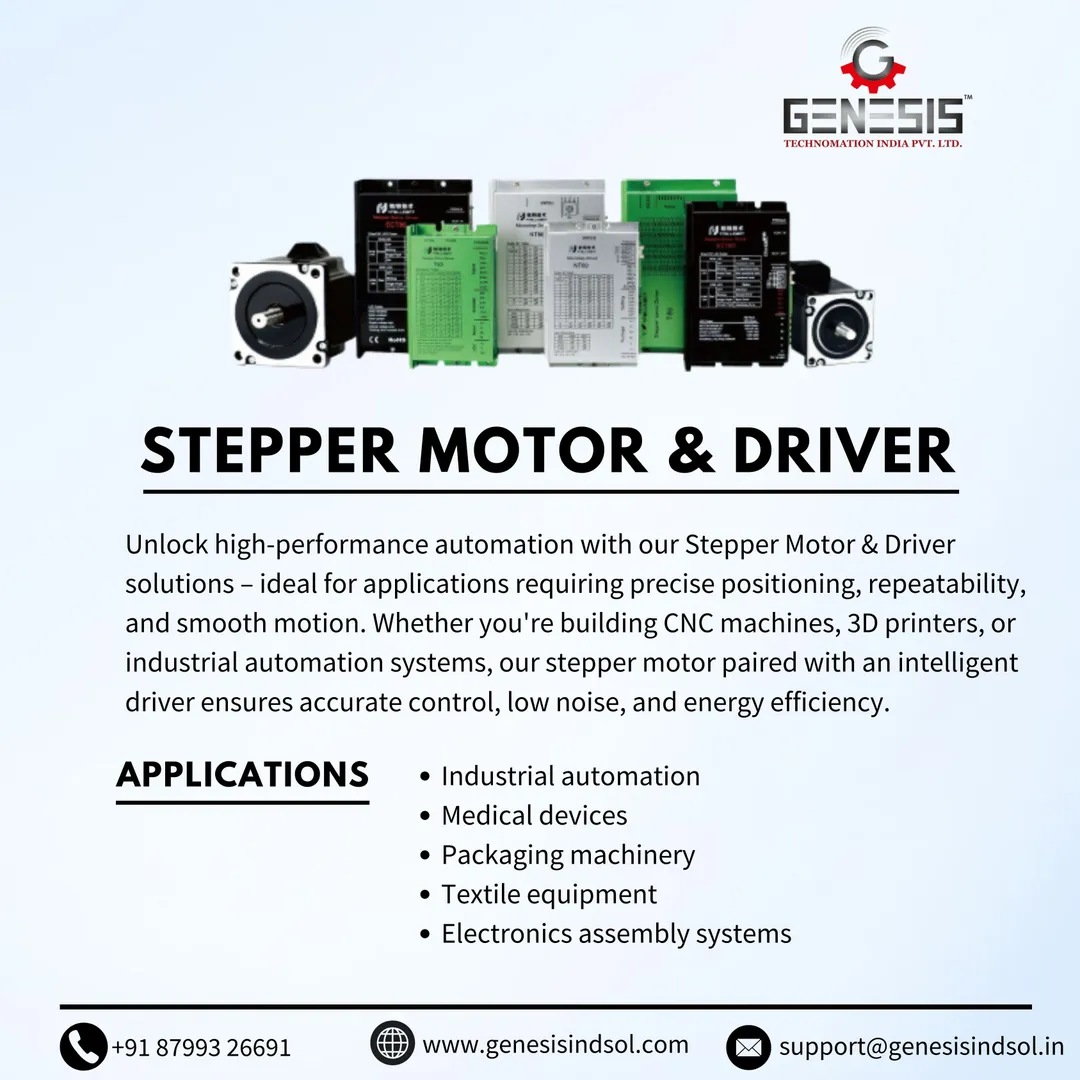
A stepper motor is an electromechanical device that converts electrical pulses into discrete mechanical movements. Each pulse moves the motor shaft by a fixed angle, called a 'step.' This precise control makes stepper motors ideal for applications requiring accurate positioning, speed regulation, and repeatability.
Key Features:
Open-loop control (no feedback required)
High positioning accuracy
Excellent torque at low speeds
Low maintenance (brushless design)
A stepper driver is an electronic device that sends the necessary current pulses to the stepper motor, enabling it to rotate step-by-step. It translates control signals from a controller (like Arduino, PLC, or microcontroller) into precise motion commands.
Functions of a Stepper Driver:
Pulse generation and modulation
Current control
Microstepping (increases resolution and smoothness)
Protection
Keywords